
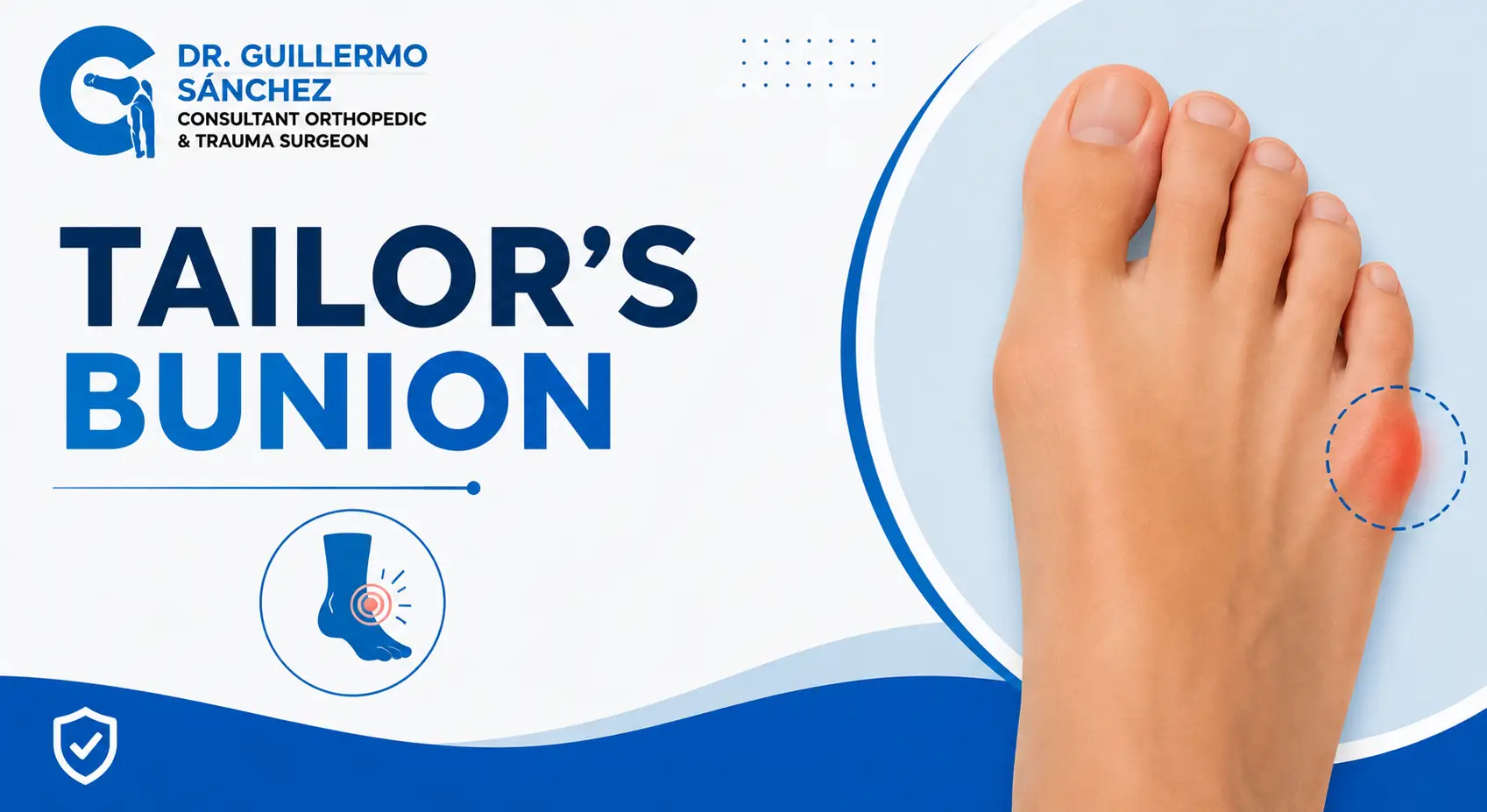
Noticing a hard, sore bump on the outer edge of your foot near your little toe can be unsettling. The good news up front: a tailor’s bunion is a common, well-understood foot problem, and most people get real relief without ever needing surgery. This guide walks you through what it is, why it happens, how it changes over time, and every treatment option, in plain language.
A tailor’s bunion is a bony bump that forms on the outside of your foot, right where your little (pinky) toe meets the rest of your foot. Doctors also call it a bunionette, which simply means “little bunion.”
You may have heard of a regular bunion, the bump that forms on the inner side of the foot by the big toe. A tailor’s bunion is its mirror image. It sits on the opposite edge, at the joint of the fifth toe. That joint has a medical name, the fifth metatarsophalangeal (MTP) joint, but you can just think of it as the knuckle of your pinky toe.
The name comes from history. Centuries ago, tailors sat cross-legged on the floor for hours, with the outer edges of their feet pressed against hard surfaces. That constant pressure led to bumps in exactly this spot, and the name stuck.
Over time, the long bone behind your pinky toe (the fifth metatarsal) slowly drifts outward, while the toe itself leans inward. This pushes the joint out to the side and creates the bump you can see and feel.
A tailor’s bunion can be easy to spot, but the symptoms vary from person to person. Common signs include:
Some people have a clear bump with almost no pain. Others have plenty of pain even before the bump looks dramatic. Both situations are normal.
It is easy to assume your shoes are entirely to blame, but the real story is usually a mix of factors. The biggest one is often something you were born with.
Foot structure and genes. Many people inherit a foot shape that makes a bunionette more likely. You might have a fifth metatarsal bone that naturally sits a little wider or has a larger head (the rounded end near the joint). Flat feet, high arches, or loose, flexible ligaments can also shift pressure to the outer edge of your foot.
Footwear. Tight shoes, narrow toe boxes, and high heels don’t usually create a tailor’s bunion on their own, but they squeeze and irritate the area, which can make the bump grow faster and hurt more.
Repeated pressure and activity. Anything that puts steady stress on the outer foot, like certain sports, lots of walking, or sitting in positions that press on the foot’s edge, can play a role.
Other factors. Extra body weight and conditions that affect the joints can also contribute.
One key point: a tailor’s bunion is a progressive condition. That means it tends to develop slowly, sometimes over many years. You might feel stiffness or mild soreness long before a bump is obvious. Paying attention early gives you the best chance to slow it down.

Doctors don’t always use strict, numbered stages, but it helps to think of a tailor’s bunion as moving through three rough phases. Knowing where you are can guide your treatment.
Early stage tailor’s bunion. The bump is small and may come and go in how much it bothers you. You might feel occasional soreness or notice slight redness only after wearing certain shoes. The bone has shifted just a little. This is the ideal time to act, because simple changes can keep it from getting worse.
Moderate stage. The bump is now clearly visible and tender more often. A callus may form from the constant rubbing. Pain shows up regularly during the day, and finding comfortable shoes starts to feel like a chore.
Advanced stage. The bump is large and may be painful even when you are resting or barefoot. The little toe can lean noticeably toward its neighbor. Skin over the bump may break down, and everyday shoes may no longer fit without pain. At this point, surgery becomes a more likely option.
The encouraging part is that many people stay in the early or moderate stage for a long time, especially with good foot care.
Getting a diagnosis is usually quick and painless. A doctor or podiatrist (a foot specialist) will look at and gently press on your foot, watch how you walk, and ask questions like when you first noticed the bump and what makes it feel worse.
They will often order an X-ray. This shows the bones clearly, confirms it’s a tailor’s bunion, and reveals how far the fifth metatarsal has shifted. The X-ray helps your doctor recommend the right treatment for your specific foot.
Here is the part most people want to hear: the vast majority of tailor’s bunions are managed without surgery. The goal of non-surgical care is to take pressure off the bump, ease your pain, and slow the condition down.
Common treatments include:
It is important to understand what these treatments can and cannot do. They are very good at relieving symptoms and slowing progression. They cannot, however, move the bone back or make the bony bump disappear, because the bump is part of your skeleton. Only surgery can change the bone itself.
Surgery is usually considered only when non-surgical treatments haven’t given you enough relief, when pain interferes with walking, or when you simply can’t wear normal shoes comfortably. It is a decision you and your surgeon make together, not an emergency.
There are a few main approaches:
Most tailor’s bunion surgeries are done as day surgery, so you go home the same day. The procedure itself is often short, around 30 to 45 minutes.
Recovery depends on the type of surgery. You will likely need to limit weight on the foot at first and may wear a special stiff-soled shoe or boot for several weeks. Many people return to regular shoes and activities within a few weeks to a couple of months, though full healing of the bone takes longer. Following your surgeon’s instructions closely, and arranging some help at home for the first day or two, makes recovery smoother.

You can’t change the foot shape you were born with, but you can lower your risk and slow things down:
It’s worth booking an appointment if you notice:
A tailor’s bunion is a common bump on the side of the foot that usually develops slowly and responds well to simple steps like better shoes, padding, and orthotics. Surgery exists and works well, but it’s a last resort for most people, not a first one. If that bump near your little toe is bothering you, a foot specialist can confirm what’s going on and build a plan that fits your life, so you can get back to walking comfortably.
Connect with Dr. Guillermo Sanchez. He is a Spanish Board-certified Orthopedic Surgeon in Dubai, with a special focus on foot and ankle conditions.
With a little care and patience, most people get back on their feet, comfortably.