
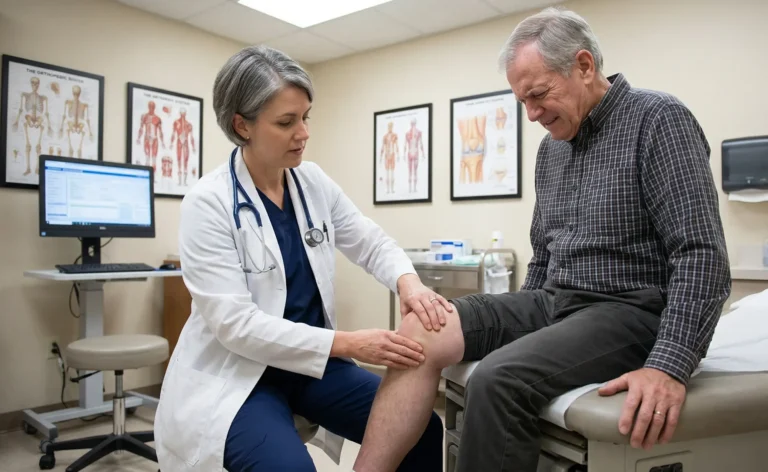
A patellar tendon rupture is not the kind of knee injury you can “walk off.” One moment your knee feels normal, and the next you may not be able to straighten your leg, climb a step, or even stand without the knee giving way.
Many people notice sudden pain at the front of the knee, swelling that builds quickly, and a feeling that the leg has lost its support.
In this blog, you will learn what a patellar tendon rupture actually is, the most common patellar tendon tear causes, the signs that suggest a ruptured patellar tendon, and how doctors confirm the diagnosis.
The patellar tendon is a tough band of tissue that runs from the lower edge of the kneecap to the top of the shinbone. It plays a central role in how the knee works.
When you straighten your leg, stand up from a chair, walk upstairs, or push off the ground to jump, this tendon is carrying force from the thigh muscles towards the lower leg. When it is healthy, these movements feel smooth and controlled. When it is injured, even simple actions can become difficult or impossible.
When this tendon tears completely, the knee loses its ability to extend. This is why a ruptured patellar tendon is considered a disabling injury that almost always requires surgical repair.
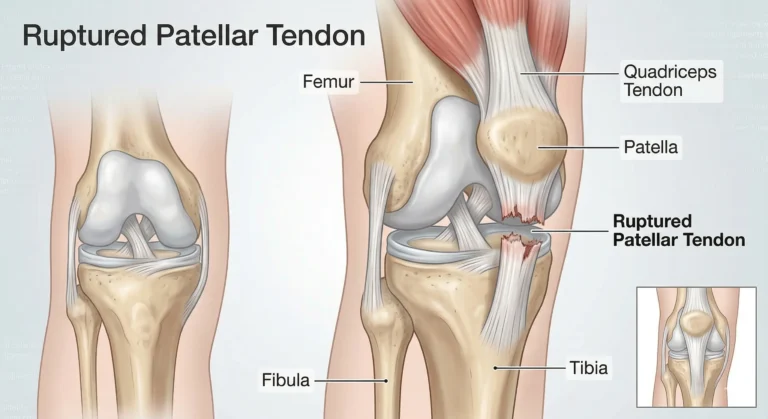
A healthy patellar tendon is extremely strong. A rupture usually occurs when high force meets a tendon that is either overstressed or already weakened.
Common patellar tendon tear causes include
Factors that weaken the tendon
In rare cases, both knees can be affected at the same time, a condition known as bilateral patellar tendon rupture, which is often linked to underlying systemic disease or medication use.
A complete rupture usually announces itself clearly. Patients often describe a popping or snapping sensation followed by intense pain just below the kneecap.
Typical signs include
Partial tears may cause pain and weakness but still allow some knee extension. They require a careful assessment to avoid progression to a full rupture.
Diagnosis begins with a focused clinical examination. Difficulty extending the knee is a key finding.
Imaging studies help confirm the diagnosis and assess the severity:
Prompt diagnosis is critical as delayed treatment can allow the tendon to shorten and scar, making repair more difficult.
Treatment is planned as per the size of the tear, functional loss, and patient factors such as age and activity level.
Small partial tears may sometimes be managed without surgery. This approach typically includes:
Close monitoring is essential. When function does not improve, surgery may be required.
Complete ruptures usually require surgery to reattach the tendon to the kneecap. Early repair offers the best outcomes and lowers the risk of long-term weakness.
During surgery, the tendon is secured using strong sutures or anchors, carefully tensioned to restore normal kneecap position. In chronic patellar tendon rupture, where the injury is old, graft tissue may be needed to lengthen or reinforce the tendon.
Recovery is gradual and requires commitment to rehabilitation.
During the early healing phase, the knee is protected in a brace to keep it stable. Movement is limited, and weight-bearing is carefully controlled, often with the support of crutches. This period allows the repaired tendon to heal without excess strain.
As healing progresses, gentle knee movement is gradually introduced. Supervised physiotherapy focuses on restoring the range of motion and beginning light strengthening exercises, particularly for the quadriceps muscles.
Rehabilitation becomes more active. Exercises now focus on rebuilding muscle strength, improving balance, and retraining the knee for everyday movements such as walking longer distances, climbing stairs, and light functional tasks.
Patients slowly return to higher-level activities, including sports or physically demanding work, depending on their progress. Strength, coordination, and confidence in the knee continue to improve during this phase.
Most patients regain good overall knee function. However, full strength and endurance can take up to a year, especially for those returning to sports or heavy physical activity.
With timely surgery and consistent rehabilitation, many individuals return to work, routine daily activities, and recreational sports. Some degree of stiffness or mild strength difference between the legs can remain, particularly if treatment was delayed.
Possible long-term issues include reduced knee motion, persistent weakness, or, in rare cases, re-rupture of the tendon. These risks are higher in untreated injuries or in chronic patellar tendon ruptures where surgery was postponed.
Treating complex knee injuries requires careful judgment and precise planning. Dr. Guillermo Sanchez brings extensive international experience in orthopedic surgery, sports-related injuries, and trauma management.
His approach prioritizes accurate diagnosis, timely treatment, and rehabilitation that reflect each patient’s daily demands and long-term goals.
By combining proven surgical techniques with structured, closely guided rehabilitation, his focus is on restoring mobility while reducing the risk of long-term limitations.
If you are experiencing sudden knee pain, weakness, or difficulty straightening your leg, early evaluation is essential. Timely care can make the difference between a smooth recovery and lasting impairment.
Book an appointment with Dr. Guillermo Sanchez to address any knee issues for a pain-free life.